Monday, 11 February 2013
ISMB Virtual Open Day - Me as Host
Once again I tried my hand at hosting a live streamed 1 hour open day for the University of Applied Sciences. This time it was even better than last years effort. Not bad for an amateur. The blinking is annoying, but hey even Dutch presentor Jeroen Pauw has that trouble.


Wednesday, 21 November 2012
Pursuit of happiness - what formula makes us happy

I came across a video on Ted.com and this slide particularly interested me during the Ted talk. The researcher outlined the formula for happiness and I thought I would share it.
As we already knew it isn't about money and financial reward!
It seems the greatest level of happiness is achieved when your skills are highest and challenge is highest and you find yourself in the "flow".
But unfortunately, according to the researcher giving the talk, the majority of people find themselves in the apathy section, low skills and low challenge in the bottom left hand corner.
On the other hand when people do find themselves in the "flow" they become so ecstatic and they are so passionate about that thing they are doing, they forget time, hunger and even pain. Their focus shuts out all other senses and feelings. It seems then that "flow" maybe it is not a place you want to be 100% of the time, down time is needed.
The "flow" is also what top professional sporters talk about when they are performing at their best. Being in the flow is a place you need to be to perform to your highest level. According to athletes it gives them the feeling of floating - that despite the challenge that is thrown at them, their skill level is so high that they will over come any of these challenges.
This formula has helped me figure out what makes me tick and what direction I should take at times, I hope you find it useful too.
Tuesday, 9 October 2012
Selling NRC Next Subscriptions with students on the streets [Sales + Accountmanagement HVA MIC course]
The past
few weeks have been challenging but so much fun!:)

Last week I
wasn’t standing in a lecture theatre [or even recording a virtual eClass]
lecturing students about what is sales is [or worse still citing definitions of
sales]. I was out on the streets of Amsterdam showing, coaching [with Pepperminds], motivating and
helping my media marketing students actually sell NRC
Next subscriptions.
Why has it been a challenging few weeks? Learning by doing is still in its
infancy even at Applied Science Universities [HBO] and you know what happens
when you go against the status quo and do something innovative and different! It
isn’t an easy ride to say the least. Actually doing real assignments for
real companies is one of the 5 ways I outlined in a new
strategy canvas for the HVA to create a win/win situation for the HVA and
its stakeholders [students being one of them and the business world being the
other]. Plus solving the age old issue of marketers and sales people clashing, will be easier when tackled earlier rather than later, while marketers are being educated.
Why was it on the flip side so much fun? Normally you experience students in
a classroom or in one-on-one coaching moments [they are very different in both
these situations/ locations!] Now I got to see the students in action!
That was loads of fun. Once the students were busy on the streets having
conversions with people walking by, they moved from a mental state of “I really don’t want to be doing this” to
“Wow I am getting good at this, I really
want to make another sale today”. I was really proud of them!! Not only did they learn loads, they also sold 350 subscriptions to very satisfied customers. Gosh if only I could experience that more
often, it would make being a part-time teacher even more rewarding.
Well I had
more great news for my media students this week. The new account management
assignment selling advertising space for the paper Z!Krant [The Big Issue of Holland] via an eBay auction, is the ultimate answer to the most common
complaints from students about their study and assignments. “Not another assignment about the biggest publisher of magazines in Holland!” …. “I would prefer to sell for a charity rather
than a commercial organization!”… “Selling face-to-face is so 2008, we should be selling via social media!” … “We should be doing projects that are innovative and refreshing!”
I wonder if
this week is going to be as challenging and/or as fun as last week??? Surprise me!!
Sunday, 1 July 2012
Olympic Athletes Hub - Thanks from Seb Coe

This week I stumbled across an announcement in SportNext magazine about the launch of the social media platform for the Olympics 2012 - The Olympics Hub.
When I contacted Sir Sebastian Coe back in 2010 about investing in my sports networking site www.esporters dot com - he thanked me "for my suggestion" - it seems it has taken them over 2 years to launched this site. Back in January 2010 Seb Coe wrote that "we are currently in the process of building this and plan to launch in 2010".
My site was aimed at achieving more than just a summary of what is already being said by the top stars [who already have loads of publicity]. It was a way for talent / up-coming athletes to profile themselves and develop fans and a support network round them to help them achieve their sporting goals.
Although my site www.esporters dot com is no longer live, it is great to have a signed letter from the great man himself - Sebastian Coe. However I wish he had listened more carefully to my "suggestion" as he could have achieved so much more with a site which had more legacy value by helping "talent" create a support nework/fans and not just get the current stars more exposure during the Olympics, which lacks legacy.
Wednesday, 27 June 2012
It's not every day you get to pitch your business idea ...
This weekend I was a participant in the "Entrepreneurs pressure cooker weekend 2012" at the HVA. It took place in the inspirational new "Studio HVA" in Amsterdam.
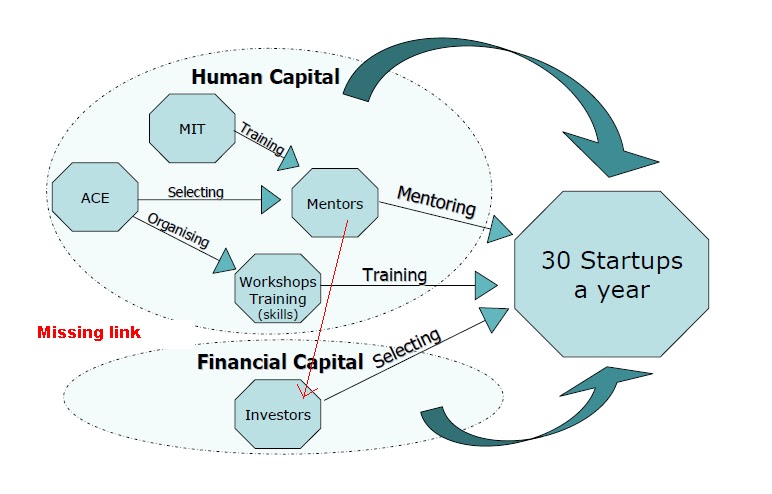
It was a full programme of inspirational speeches from entrepreneurs like Boris Veldhuijzen van Zanten, but mainly brainstorming your own business concept and ideas with colleges and the coaches and the Manager of ACE Martin Haring.
It isn't every day you get to pitch your business idea to a couple of multi-millionairs and serial entrepreneurs. Wow it was nerve racking but so much fun.
I began with three very rough ideas I thought of before the weekend and whittled it down to two on the day and then one that I pitched to the jury:
Idea 3: The Collaboration Games - After talking with some experts it seems this idea was too similar to other offerings and would be difficult to scale.
Idea 2: VC Young Entrepreneurs - As it turns out the idea was not new, there is a plan for this in the "valorisatie" plan in Amsterdam.

 Idea 1: OwnBrand for topsportswomen - This is the idea I pitched [watch video]. I am passionate about building the brands and image of top sports women in the non-mainsteam sports. [Think ... squash ... do you know who the 7 times womens world champion is?] Equally there is a market, it is sellable via a webshop, it achieves a bigger mission than just profit, it is scalable and it is possible within my current network and capabilities, however it does need a bit of initial investment.
Anyway I didn't win the pitch! But I really improved my pitch technique and was very satisfied with my effort. It is incredibly difficult in 1 minute to get across to the jury:
I just hope my business idea pitch was better than my karaoke performance!?!?
It was a full programme of inspirational speeches from entrepreneurs like Boris Veldhuijzen van Zanten, but mainly brainstorming your own business concept and ideas with colleges and the coaches and the Manager of ACE Martin Haring.
It isn't every day you get to pitch your business idea to a couple of multi-millionairs and serial entrepreneurs. Wow it was nerve racking but so much fun.
I began with three very rough ideas I thought of before the weekend and whittled it down to two on the day and then one that I pitched to the jury:
Idea 3: The Collaboration Games - After talking with some experts it seems this idea was too similar to other offerings and would be difficult to scale.
Idea 2: VC Young Entrepreneurs - As it turns out the idea was not new, there is a plan for this in the "valorisatie" plan in Amsterdam.

 Idea 1: OwnBrand for topsportswomen - This is the idea I pitched [watch video]. I am passionate about building the brands and image of top sports women in the non-mainsteam sports. [Think ... squash ... do you know who the 7 times womens world champion is?] Equally there is a market, it is sellable via a webshop, it achieves a bigger mission than just profit, it is scalable and it is possible within my current network and capabilities, however it does need a bit of initial investment.
Anyway I didn't win the pitch! But I really improved my pitch technique and was very satisfied with my effort. It is incredibly difficult in 1 minute to get across to the jury:
- What's in it for you? [Emotion]
- What problem can be solved with this solution? [Market potential]
- For who is the solution? [Target market]
- What is the solution and what does it cost? [Concept & business model]
- What I want from you? [call to action]
I just hope my business idea pitch was better than my karaoke performance!?!?
Tuesday, 26 June 2012
eLearning Experiments and A New Strategic Canvas For the HVA
eLearning is all the rage now in education. Yesterday I participated in a 4 hour session with other teachers/lecturers from the HVA [University of Applied Sciences] about "Learning Tomorrow". But I think we are missing the point by getting so caught up in technology and ICT.
I have been trialing a few little experiments [the non scientific type] to see what works best with students in terms of eLearning i.e. what makes them more "active" = thinking = learning. These experiments include; creating knowledge clips [10 minute videos with theory], asking students to create videos instead of written reports as assignments, using Facebook to communicate with students, using a Facebook group to start discussions, polling students via FB for exam questions and using online articles instead of books.
 I am not seeing the difference! There has not been more participation, but there has been more complaining unfortunately. But certainly not more giving their opinion about a topic or article related to the subject.
Students suggest teachers should get with the programme and use more up-to-date ICT methods. However, when, in one of my innovation classes, I tested my strategy canvas for a new value curve for the University, the majority of students didn't like the idea of not having face-to-face lectures.
I have noticed that while doing these eLearning experiments, the moment that I get the students thinking the most, is when they are physically taking part in a relevant [subject related] discussion among themselves and with me in class. Remember that Chinese proverb: “Tell me and I'll forget; show me and I may remember; involve me and I'll understand” ... hmmm a relevant proverb for marketers & teachers alike!

I presented to them the following changes to the HVA, using the creation of a new value curve on a Strategy Canvas [Blue Ocean theory]:
Well the students were very enthusiastic about some of the new value curve, but seriously worried about loosing physical contact. This was reinforced again yesterday when the two students present in the eLearning meeting, suggested that "ICT is all good and well, but there needs to be a balance of physical, face-to-face contact combined with the online stuff".
Yep ... balance. We need to be sure we don't swing like a pendulum to over digitalize our education and loose the all so necessary contact and coaching moments. This balance is in the Strategy Canvas above, and at the same time this new value curve sets HVA apart from its competition [or the average competition] and could create a sustainable competitive advantage.
I have been trialing a few little experiments [the non scientific type] to see what works best with students in terms of eLearning i.e. what makes them more "active" = thinking = learning. These experiments include; creating knowledge clips [10 minute videos with theory], asking students to create videos instead of written reports as assignments, using Facebook to communicate with students, using a Facebook group to start discussions, polling students via FB for exam questions and using online articles instead of books.
 I am not seeing the difference! There has not been more participation, but there has been more complaining unfortunately. But certainly not more giving their opinion about a topic or article related to the subject.
Students suggest teachers should get with the programme and use more up-to-date ICT methods. However, when, in one of my innovation classes, I tested my strategy canvas for a new value curve for the University, the majority of students didn't like the idea of not having face-to-face lectures.
I have noticed that while doing these eLearning experiments, the moment that I get the students thinking the most, is when they are physically taking part in a relevant [subject related] discussion among themselves and with me in class. Remember that Chinese proverb: “Tell me and I'll forget; show me and I may remember; involve me and I'll understand” ... hmmm a relevant proverb for marketers & teachers alike!

I presented to them the following changes to the HVA, using the creation of a new value curve on a Strategy Canvas [Blue Ocean theory]:
- Less physical lectures - more virtual web colleges.
- Less physical half days at Uni - replaced by one full intensive day at Uni - with intensive small workshops - with lots of interaction. [Less physical days at school also means students can better combine work/study/own business].
- Less exams at end of year - more test moments when the student wants at different moments during the course [digitally is an option of course].
- Less feeling like a number at Uni - more intensive coaching one-on-one face-to-face or via skype video.
- Less abstract/virtual assignments - more REAL external assignments with companies [possibly paid - like the HVA & Pepperminds assignment]
Well the students were very enthusiastic about some of the new value curve, but seriously worried about loosing physical contact. This was reinforced again yesterday when the two students present in the eLearning meeting, suggested that "ICT is all good and well, but there needs to be a balance of physical, face-to-face contact combined with the online stuff".
Yep ... balance. We need to be sure we don't swing like a pendulum to over digitalize our education and loose the all so necessary contact and coaching moments. This balance is in the Strategy Canvas above, and at the same time this new value curve sets HVA apart from its competition [or the average competition] and could create a sustainable competitive advantage.
Monday, 4 June 2012
My Mum is sooo cool ... happy birthday for today!
 My Mum is soooooo cooooool.
 How many women in their 60's do you know who are building websites themselves? Using dreamweaver I may add, not a free blogger.com programme like this one [that I use for this blog!].
She is building her second website and getting a real taste for it! She started with a site for her organisation - the "Medway dyslexia Association": http://www.medwaydys.org/ and her latest creation for "British Flora" will be going live shortly.
 When you take a look at the Forrester social technographics data about +55's and their desire to be "creators" online my Mum is pretty unique!! And she is older than that group.
Not only does she build websites but volunteers her time for organisations, committees and causes that she is passionate about ... dyslexia and gardening!! She teaches young children ways of coping with dyslexia and helps them get the best out of themselves - with some going on to University and thriving in creative roles. She should feel very proud of herself.
Above is a picture of my Mum with my nephew - making cakes together. Doesn't she look great for her age! BTW how did she manage to keep that kitchen spotless during that activity!
Mum ... you are the coolest ... HAPPY BIRTHDAY for today. Enjoy yourself and I hope you get spoilt rotten, by Dad in particular.
Love Claire
XXX
Subscribe to:
Posts (Atom)